
[Book Review] Driving Value with Sprint Goals
By Maarten Dalmijn


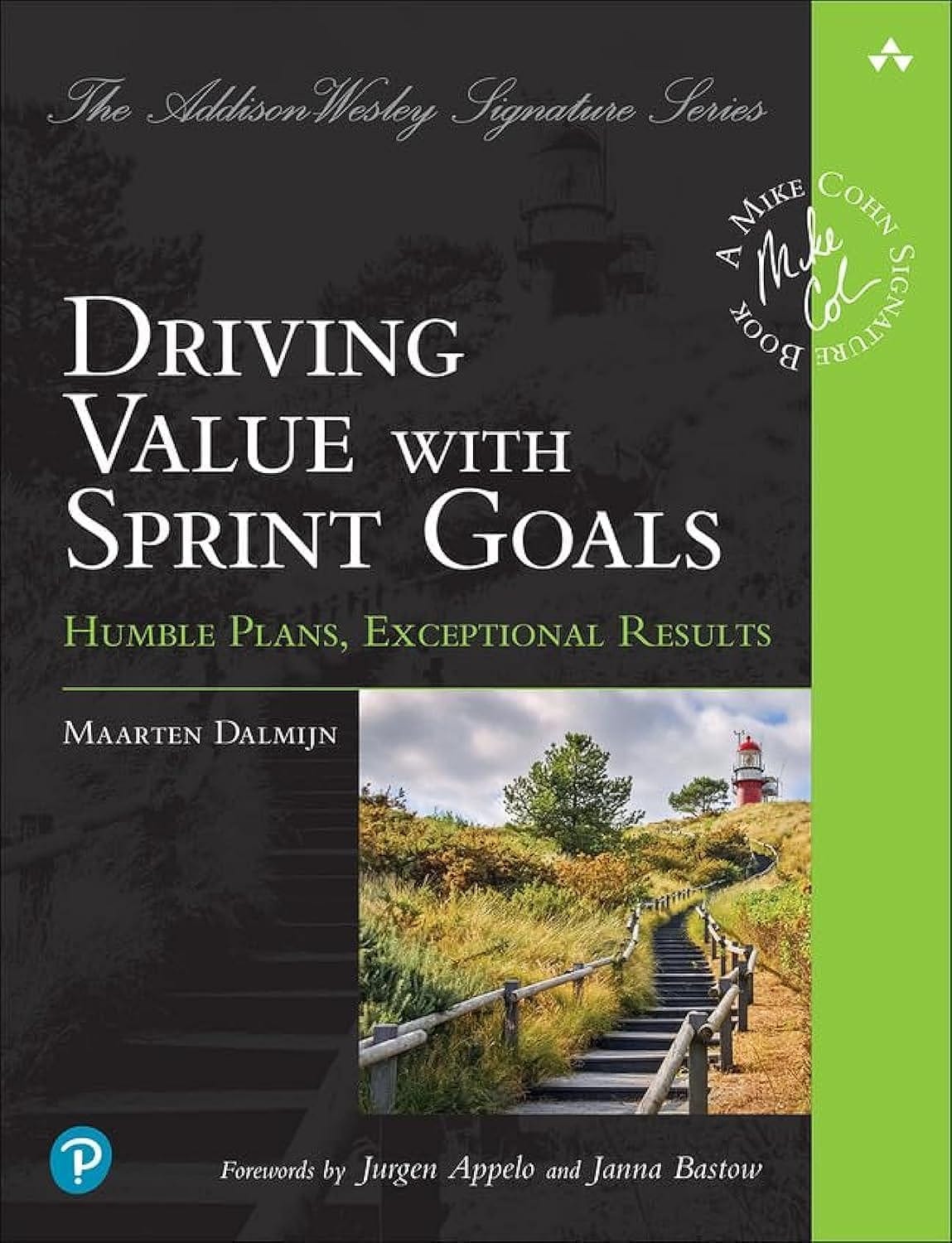
At the Agile Mindset, we are always looking for ways to improve ourselves. Sometimes this leads to more philosophical books, like the previous review we did. Other times it is a deep dive into something we already use and know, but want to know more of. Maarten Dalmijn wrote `Driving Value with Sprint Goals`. He takes us along an interesting journey. It starts with Dutch lighthouses and then explores complexity in the Cynefin framework. The journey ends with delivering value with and a couple of anti-patterns in scrum teams. Sprint goals seem to be a very straightforward topic. It might be weird to write a 215 page book on the topic, but let’s see how Maarten scrutinises the subject.
At the start of the book, you can immediately tell Maarten loves a good story. Throughout the book he resorts to good analogies to make his point. The very first one he mentions is a story straight from his youth. His writing style is so vivid, you can close your eyes and see the story unravelling in front of your eyes. The story is a nice introduction to why the future embodies uncertainty. It shows that planning every step along the way only leads to pure speculation. You can't know for sure until you reach your target. Speculation which in its turn adds uncertainty and complexity. This is something he calls Fog of Speculation. Something which often is the result of wanting to clear The Fog of Beforehand. This is also known as the unknown unknowns.
This complements something we already wrote about: The Cynefin Framework. If you are talking about complexity and unknown unknowns, you cannot ignore it. Maarten takes us along the 4 quadrants and illuminates all the characteristics of each domain. It is so important that before you can talk about the solution space, you need to describe the domain you are in. The specifics of that domain dictate the possible solutions one can put in place. Scrum is such a solution. In his same lightweight writing style, Maarten covers all the details you need to know about what it is and which events take place within a scrum team. This is where the book takes a surprising turn and ventures into Product Management land. A somewhat surprising one when you see the title of the book, but a very understandable choice. A sprint goal only has true value when the team links it to an overarching product vision. If you do it right and use the sprint goal in every scrum event, a team can lift mountains."When I told people I was writing a book on Sprint Goals, the most frequent response was 'Huh? How can you write a whole book on Sprint Goals?'.
The primary goal for this book was to turn this 'Huh?' into a 'Duh!'. Why didn't anyone write a book on the topic of Sprint Goals sooner? Because to me by understanding Sprint Goals you get to the essence of what Scrum and Agile is about.
Maarten Dalmijn
The danger of writing about theories, frameworks and principles is that you remain too abstract. In the end, a lot of people need to interact with each other and are confronted with real life challenging situations. To be able to tackle these, they need tangible methods and techniques which they can use to reach their goals. Often this is what is lacking in literature, but not so in Maarten’s book. He writes about three primary gaps which you can encounter when dealing with complexity:
Knowledge gap: The difference between what we’d like to know and what we actually know.
Alignment gap: The difference between what we want people to do and what they actually do.
Effects gap: The difference between what we expect our actions to achieve and what they actually achieve.
Using these gaps as a sort of umbrella, Maarten lists several anti-patterns you can see happening within scrum teams. With very concrete examples, he also shows you what you can do to solve them and counters those anti-patterns. It is exactly in this last chapter he ties the theory to the practice, the principles to the techniques, the thought to the doing. He even briefly touches scaling scrum without the need of big, overarching frameworks. We can’t hold perhaps one of our favourite quotes from the book: ‘Scale as you solve problems, don’t scale to solve problems’. All too often people see scaling frameworks as a one size fits all checkbox to become agile. And also all too often companies fail miserably.

‘Driving value with sprint goals’ is a very to the point, well written book. It has 19 shorter chapters, each ending with the necessary key takeaways you can use as a small recap of what you’ve read. In his light and pleasant writing style, Maarten takes us along a journey which is captivating until the end. You can expect more abstract topics but also very concrete tips and tricks on how to overcome or even avoid anti-patterns in your scrum team. In the end, working with scrum teams and in extension people is a hard craft to master. Reading books like these can help people. They can learn to add value step by step. This way, they won't feel overwhelmed by too many options.
Although the title does not honour the content, you should definitely include this one. Whether you are a seasoned agile veteran, or someone who is about to start on their adventure in agile land, you definitely will enjoy reading it.